
What does resilience really mean, anyway?

Updated: Jan 12, 2019
I have always been fascinated by the phenomenon of resilience. Seeing someone overcome insurmountable obstacles is awe inspiring. It hits me in the feels every time. The concept of

resilience is thrown around a lot these days. Unfortunately, though, there is still a lot of misinformation floating around when it comes to what exactly resilience means. So, let's start by reviewing the definition given by the gurus at the Resilience Research Centre and see if we can make any sense of it:
“In the context of exposure to significant adversity, resilience is both the capacity of the individual to navigate their way to the psychological, social, cultural, and physical resources that sustain their well-being, and their capacity individually and collectively to negotiate for these resources to be provided in culturally meaningful ways.”
Now that's a mouthful! Let's break it down a bit, shall we?
In laymen's terms, resilience is best understood as the following: When life knocks you down (adversity), you have the inner strength and capacity and the outer support to get the help you need to get back up and keep going.
That is what resilience is all about: knowing how to bounce back!
I really need to emphasize the "bouncing back" part, because some people view resilience as how much a person can endure and still be alive. For example, a homeless person who is suffering from addiction is not an example of resilience. They are still suffering! Resilience is about overcoming. It is about surviving AND thriving in the face of adversity.
Okay, okay, we know that resilience is about bouncing back, but is there some particular gene that resilient people are born with? A special gene that allows someone to overcome any challenge or obstacle thrown their way? Is there a "resilience lottery" some of us win at birth? Or is resilience something learned from one's environment?
WHICH ONE IS IT? NATURE OR NURTURE?
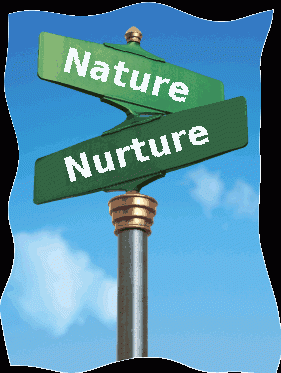
Well, it's a bit of both actually.
The long-held debate of nature vs. nurture has finally been put to rest (for now, anyway). And the victor is...
BOTH!
Our current understanding is nature through nurture. And there is an entire field of research devoted to studying this phenomenon, and it is called Epigenetics. Type Epigenetics into the Google machine and see what pops up. It's pretty fascinating stuff!
According to Epigenetics, resilience is built through the interplay between the genetics of the individual AND his or her environment. The environment can actually turn up or turn down genetic expression. In other words, if someone is born with a genetic predisposition for aggression, but they are reared in a loving and supportive environment, that loving environment could work by turning down the genetic expression of aggression; ergo, making them less aggressive.
Now that is pretty dang cool, right?
It means that there is no "resilience lottery," per se. Yes, some people are born more resilient than others, but the environment plays a MUCH LARGER role in growing resilience than we previously thought. Let's take a minute or two and look at how resilience is built.
Resilience: A Balancing Act

For the visual learners out there, think of one's resilience as a teeter-totter. The left seat of the teeter-totter is where adverse life experiences live, and the right seat is where positive life experiences live. The middle section or the pivot point is the individual's genetics and represents the nature part of the equation.
Our genes (middle of the teeter-totter), at the start, may be positioned more toward one seat or the other; towards positive life experiences or negative life life experiences. If the environment the child is reared in has more positive experiences than negative it is like putting a heavier kid on the positive life experiences seat, making it more likely the individual will become resilient. The opposite is also true; if someone lives in an environment full of adversity it is like putting the heavier kid on the left seat making the likelihood of becoming resilient less probable.
So, how do we tip the scales toward positive life experiences?
One factor that holds a TON of weight to tip the scales in favour of positive outcomes and resilience is...drum roll, please... HEALTHY RELATIONSHIPS!
The more people that we have a deep-rooted, trusting connection with the more likely we are to have positive life outcomes and be resilient. A healthy support network of caring adults is truly worth its weight in gold. Check out the 3-minute video below from Harvard that explains the process in more detail. It is worth your time, I promise. And, it's only 3 minutes so, really, just watch it already!
HARVARD: THE SCIENCE OF RESILIENCE
The Take-Home Message
Humans are a tribal species, and we have been for millennia. We survive and thrive in groups. But the sad reality is as I write this we are the most lonely we have ever been in history.
And it is killing us...
So, what is the magic panacea to build resilience, then? Well, you may have figured this out already, but if you didn't, the magic bullet for building resilience is RELATIONSHIPS!
Seems too simple, right? Well, it's not, my dear friend.
If we want to increase resilience in ourselves and our loved ones, the key is positive relationships. And by positive relationships, I am referring to the old-fashioned, face-to-face interpersonal relationships that we have been engaging in for eons.
No screens allowed!
If you invest time and energy into creating and sustaining healthy relationships the return on investment will be exponential, for both your mental AND physical health; and for both yourself AND your loved ones!
Double-win!
Life will knock you down (trust me), so make sure you have a network of people ready to lend you a hand and pull you back up. Take some time and evaluate your resilience. If you need to cut some people loose because they are dragging you down and decreasing your resilience, do it NOW! What are you waiting for? If you are feeling lonely and isolated (and a lot of us are these days) then add some people to your support network and see how quickly you feel better.
It isn't rocket science, people. It's relationships!
That my friend, is what resilience is all about.
Until next time....
- JB Fletcher
Suggested Reading
Werner, E. E., & Smith, R.S. (1992).
Overcoming the odds: High-risk children from birth to adulthood. Ithaca, NY: Cornell University Press.
References
1. Definition of Resilience
Resilience Research Centre (2019)
Retrieved from: http://www.resilienceresearch.org/about-the-rrc/resilience/14-what-is-resilience
2. Harvard Video on Science of Resilience
Retrieved from: https://www.youtube.com/watch?v=1r8hj72bfGo
Comments